
Managing local search visibility for one location is straightforward. Managing it for ten, fifty, or two hundred locations—while maintaining ranking consistency, brand coherence, and lead attribution accuracy—is a fundamentally different operational challenge. Most multi-location businesses discover this the hard way: what worked for their first three locations breaks completely when they scale to thirty.

Local SEO for multi-location businesses requires a systematic framework that treats each location as both an independent local entity and a coordinated part of a broader brand presence. This means optimizing individual Google Business Profiles with location-specific content, building consistent NAP (Name, Address, Phone) citations across hundreds of directories, creating locally relevant landing pages that don't cannibalize each other, and implementing tracking systems that attribute leads to specific locations accurately. When executed correctly, this approach typically increases local pack visibility by 40-60% across all markets within 90-180 days.

At Sting Marketing, we've implemented multi-location local SEO strategies for businesses ranging from regional insurance agencies to national home service franchises. This article breaks down the exact methodology we use—the same data-driven approach that has driven measurable results for entrepreneurial businesses since 1997.
Why Multi-Location Local SEO Breaks at Scale
The challenge isn't that local SEO stops working for larger organizations. The challenge is that the tactics designed for single-location businesses create compounding problems when applied across multiple markets.
Consider the math: a single location might require optimization across 50-100 citation sources, one Google Business Profile, and one local landing page. Multiply that by 25 locations, and you're managing 1,250-2,500 citations, 25 GBP profiles, and 25 landing pages—each requiring consistent information, unique local signals, and ongoing maintenance. According to BrightLocal's 2024 Local Consumer Review Survey, 98% of consumers used the internet to find information about local businesses in the past year, with 76% reading online reviews regularly. Each of your locations is competing for that attention independently.
The most common failure patterns we see when auditing multi-location businesses include:
- NAP inconsistency: Different phone formats, address variations, or outdated suite numbers create trust signals that confuse both Google and potential customers
- Duplicate content penalties: Location pages that use identical copy with only city names swapped provide no unique value and can trigger algorithmic filtering
- GBP management chaos: Profiles created by former employees, claimed by different accounts, or abandoned after location changes create verification nightmares
- Cannibalization: Multiple locations competing for the same keywords without geographic differentiation, splitting ranking authority instead of building it
These aren't theoretical problems. When we conduct visibility audits for multi-location businesses, we typically find that 30-50% of their locations have at least one critical local SEO issue actively suppressing their local pack visibility.
The businesses that treat this as a systems problem rather than a marketing problem are the ones that scale successfully. That's the shift in thinking this strategy requires.
The Multi-Location Local SEO Framework
Effective multi-location local SEO operates on three interconnected layers: centralized brand architecture, location-level optimization, and cross-location coordination. Each layer serves a distinct function, and weakness in any layer undermines the others.
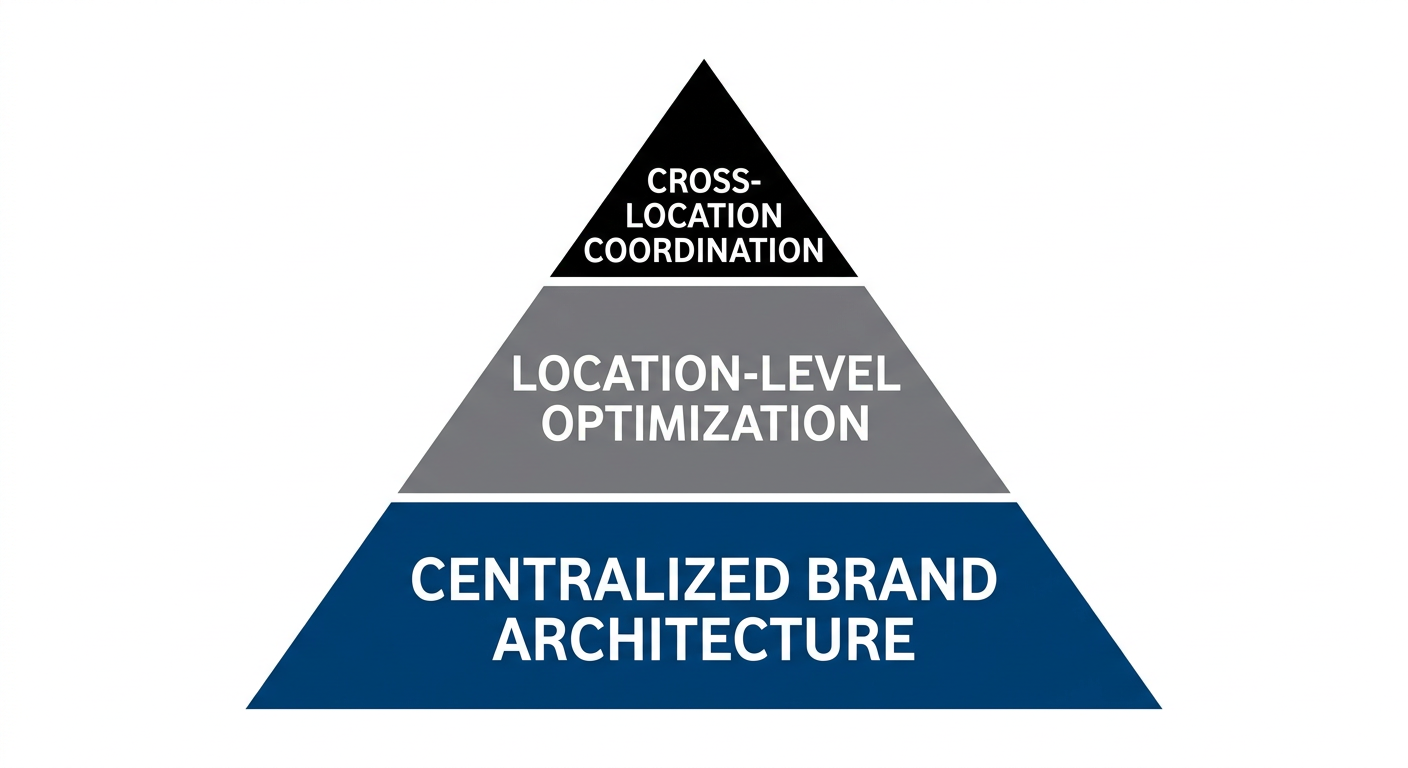
Layer 1: Centralized Brand Architecture
Before optimizing individual locations, you need infrastructure that supports scale. This means establishing:
A unified GBP management system. Every location's Google Business Profile should be accessible through a single Business Profile Manager account or agency dashboard. When we onboard multi-location clients, we audit existing profile ownership, consolidate access, and establish verification protocols that prevent future fragmentation. Google's own documentation for bulk location management provides the technical framework, but implementation requires systematic execution.
Standardized NAP formatting. Choose one format for your business name, one structure for addresses, and one phone number strategy (local numbers vs. tracked numbers vs. toll-free). Document these in a style guide that every team member and vendor follows. Inconsistency accumulates silently—by the time you notice the problem, you're cleaning up citations across dozens of directories.
A scalable website architecture. Your location pages need a URL structure that's both user-friendly and crawlable. The most effective pattern is typically /locations/[state]/[city]/ or /[city]-[service]/ depending on your service model. Each location page should be internally linked from a locations index page and cross-linked to relevant service pages. This is where conversion-focused web design intersects with SEO—the architecture must serve both search engines and the humans trying to find and contact specific locations.
Layer 2: Location-Level Optimization
With centralized infrastructure in place, each location requires individual optimization that creates genuine local relevance—not just city-name substitution.
Google Business Profile optimization goes far beyond basic information. Each profile needs:
- A complete and accurate primary category plus relevant secondary categories
- Services and products listings specific to what that location actually offers
- Location-specific photos (exterior, interior, team, work examples) updated quarterly at minimum
- Regular Google Posts featuring local events, promotions, or content
- Active review generation and response protocols
- Accurate attributes (accessibility, payment methods, amenities)
Location landing pages must provide unique value. This means original content about the specific community served, locally relevant service descriptions, embedded Google Maps, location-specific testimonials, and schema markup that clearly identifies the business type and geographic service area. According to Google's structured data guidelines, LocalBusiness schema helps search engines understand your location information—but only when implemented correctly with accurate coordinates and service area definitions.
Citation building requires a prioritized approach. Focus first on the data aggregators (Data Axle, Localeze, Foursquare, Neustar) that feed hundreds of downstream directories. Then address industry-specific directories relevant to your vertical. For insurance agencies, that means carriers and industry associations. For medical practices, that means health-specific directories and hospital affiliations. For home builders, that means real estate platforms and local business chambers.
Layer 3: Cross-Location Coordination
The final layer prevents your locations from competing against each other while maximizing collective authority.
Geographic keyword strategy assigns primary and secondary keywords to each location based on actual search volume and competitive density in that market. A Phoenix location and a Scottsdale location shouldn't both target "Arizona [service]"—they should each own their specific metro while the brand strategy captures state-level terms on service pages.
Internal linking architecture distributes authority strategically. Your highest-authority pages (typically the homepage and main service pages) should link to location index pages, which link to individual location pages. Location pages can cross-link to nearby locations for "also serving" signals, but should primarily link up to service content rather than sideways to competing locations.
Review management at scale requires both automation and human oversight. Automated review request sequences ensure consistent solicitation across locations, while human review response maintains brand voice and handles sensitive situations appropriately. The goal is review velocity (new reviews consistently) plus review quality (detailed, keyword-rich responses from real customers).
Managing multiple locations? Sting's free visibility audit evaluates your current local search performance across every market—identifying which locations are underperforming and why. Schedule yours to see exactly where you're losing leads to competitors.
Implementation: Where to Start and What to Measure
The framework above describes the complete system. Implementation requires prioritization based on your current state and resources.
Priority 1: Audit and Consolidate (Days 1-30)
Before optimizing anything, you need accurate baseline data. This means:
- Inventory all existing GBP profiles across every location, including duplicate or abandoned profiles that need to be marked as closed or merged
- Document current NAP variations appearing across major citation sources (use tools like BrightLocal or Whitespark for efficient auditing)
- Assess website architecture for location page structure, internal linking, and technical SEO issues
- Benchmark current performance by tracking local pack rankings for primary keywords in each market
This audit phase typically reveals 40-60% of the issues suppressing your local visibility. You can't fix what you haven't measured.
Priority 2: Foundation Fixes (Days 30-90)
With audit data in hand, address foundational problems before pursuing growth tactics:
- Consolidate GBP access into a single management system
- Correct NAP inconsistencies across primary citation sources (data aggregators first, then high-authority directories)
- Fix or rebuild location landing pages that lack unique content or proper schema markup
- Implement tracking systems that attribute leads to specific locations (call tracking, form source identification, UTM parameters)
This phase is where most multi-location businesses see initial ranking improvements—not from adding new tactics, but from removing the friction that was suppressing existing authority.
Priority 3: Growth Optimization (Days 90-180)
With foundations solid, shift to growth tactics:
- Expand citation coverage to industry-specific and local directories
- Launch systematic review generation campaigns across all locations
- Create locally relevant content (community involvement, local case studies, market-specific service content)
- Build local links through sponsorships, partnerships, and local PR
Key Performance Indicators
Multi-location local SEO success is measured through:
- Local pack visibility: Percentage of locations appearing in the 3-pack for primary keywords
- GBP engagement: Views, clicks, calls, and direction requests per location
- Citation accuracy score: Percentage of citations with correct NAP across monitored sources
- Review velocity and rating: New reviews per month and average rating by location
- Organic traffic to location pages: Sessions attributed to location-specific content
- Lead attribution: Calls, forms, and conversions tracked to specific locations
When we implement conversion rate optimization alongside local SEO, we measure not just traffic but the percentage of local visitors who become leads—because rankings without conversions don't pay the bills.
What About AI Search and Multi-Location Visibility?
Traditional local SEO focuses on Google's local pack and Maps. But as AI-powered search tools like ChatGPT, Perplexity, and Google's AI Overviews become more prevalent, multi-location businesses face a new challenge: how do AI assistants recommend local service providers?
The answer, based on current AI search behavior, is that these systems pull from the same foundational data that powers traditional local SEO—Google Business Profiles, structured data, authoritative website content, and third-party citations. Businesses with strong local SEO foundations are already better positioned for AI search visibility.
However, AI assistants also prioritize businesses with clear expertise signals and comprehensive content that directly answers user questions. This is where Answer Engine Optimization (AEO) intersects with local SEO: your location pages and service content should be structured to answer the specific questions potential customers ask when searching for local providers.
For example, a user asking an AI assistant "Who are the best insurance agents in Scottsdale?" will receive recommendations based on review signals, content authority, and structured data—the same signals Google uses. The businesses winning in traditional local search are positioned to win in AI search as well.
How Long Does Multi-Location Local SEO Take to Show Results?
Local SEO timelines depend heavily on your starting position, but typical patterns we see with multi-location clients:
- 30-60 days: Initial ranking improvements from foundation fixes (NAP corrections, GBP optimization, duplicate resolution)
- 90-120 days: Measurable increases in local pack visibility and GBP engagement across most locations
- 180+ days: Compounding gains from review velocity, citation authority, and local content accumulation
Locations in less competitive markets typically see faster results. Locations in highly competitive metros (major cities, saturated industries) require sustained effort over 6-12 months to achieve dominant positioning.
No legitimate agency guarantees specific rankings—local search results depend on competitive dynamics that change constantly. What we guarantee is systematic execution of proven methodology with transparent reporting on measurable KPIs.
Should You Handle Multi-Location SEO In-House or Hire an Agency?
The honest answer depends on your scale, internal resources, and opportunity cost.
In-house management works when:
- You have fewer than 10 locations
- You have dedicated marketing staff with local SEO expertise (not just general marketing knowledge)
- You have systems for ongoing citation monitoring, review management, and content creation
- Your leadership can commit to consistent execution over 12+ months
Agency partnership makes sense when:
- You have 10+ locations or are scaling rapidly
- Your marketing team lacks specific local SEO and technical SEO expertise
- You need established vendor relationships and tools (citation management, rank tracking, review platforms)
- Your leadership's time is better spent on operations than marketing execution
Many businesses we work with started with in-house management, hit a ceiling around 15-20 locations, and engaged us to systematize what had become operationally unsustainable. The earlier you build proper infrastructure, the less cleanup you'll need later.
When we partner with multi-location businesses, we function as an extension of their marketing team—handling execution while they maintain strategic oversight. Our case studies show the specific results this approach delivers across different industries and market sizes.
What's the ROI of Multi-Location Local SEO?
Local SEO ROI varies by industry, average transaction value, and competitive landscape. However, the fundamental economics are favorable: local search captures high-intent users at the moment they're seeking a provider in their area.
Consider the math for a business with 25 locations:
- Each location generates an average of 50 monthly calls from Google Business Profile
- 20% of those calls convert to customers (10 new customers/location/month)
- Average customer value is $500
- That's $5,000/month per location, or $125,000/month across all locations
If systematic local SEO increases GBP engagement by 40% across locations, the incremental value is $50,000/month—$600,000/year from improved local visibility alone. This doesn't account for organic traffic to location pages, improved conversion rates from better-designed landing pages, or the compounding effect of review accumulation.
The businesses that view local SEO as a revenue driver rather than a marketing expense are the ones that invest appropriately and measure results rigorously.
Start With Your Highest-Opportunity Locations
If you're managing local SEO for multiple locations without a systematic framework, you're leaving leads and revenue on the table at every location—and the gap compounds as you scale.
The strategy outlined in this article represents the same methodology Sting Marketing has used with multi-location clients across insurance, healthcare, legal, and home services industries since our founding. It's not magic—it's systematic execution of proven tactics, measured against business outcomes, and adjusted based on data.
Whether you implement this in-house or work with an agency partner, the principles remain the same: centralized infrastructure, location-level optimization, cross-location coordination, and relentless measurement.
Ready to see where your locations stand? Contact Sting Marketing for a free visibility audit that evaluates your current local search performance across every market—or call (888) 858-7776 to discuss your multi-location SEO challenges directly with our team.
This article reflects Sting Marketing's experience and methodology as of the publication date. Search engine algorithms, AI platforms, and digital marketing best practices evolve continuously. For a strategy tailored to your specific business, market, and goals, schedule a free growth audit or call (888) 858-7776.