
Your competitors are getting recommended by ChatGPT, Perplexity, and Google's AI Overviews while your business remains invisible to the 100+ million people using AI assistants for purchase research. The rules that built your Google rankings don't automatically translate to large language model visibility—and the businesses figuring this out first are capturing market share that traditional SEO can't reach.
LLM optimization strategies are the specific techniques that increase your brand's probability of being cited, quoted, and recommended by AI-powered search tools. Unlike traditional SEO, which focuses on ranking web pages, LLM optimization focuses on making your content recognizable, trustworthy, and extractable by the AI models that power ChatGPT, Claude, Perplexity, Google AI Overviews, and Microsoft Copilot. Effective LLM optimization combines authoritative content architecture, entity-based structuring, and citation-worthy formatting that AI systems can parse and attribute.
This guide breaks down the methodology Sting Marketing uses to help growth-focused businesses dominate both traditional search and AI answer engines—because in 2025, you need both to capture the full spectrum of how people find solutions to their problems.
Why LLM Optimization Is Now a Revenue Problem, Not Just an SEO Problem
The shift from search engines to answer engines isn't coming—it's already reshaping how your prospects find and evaluate solutions. According to Search Engine Land's analysis, ChatGPT's search market share grew from 0% to over 1% in under two years, and Perplexity processes over 100 million queries monthly. These numbers don't capture the full picture: enterprise decision-makers and high-intent buyers increasingly use AI assistants to research vendors, compare options, and build shortlists before ever visiting a traditional search engine.

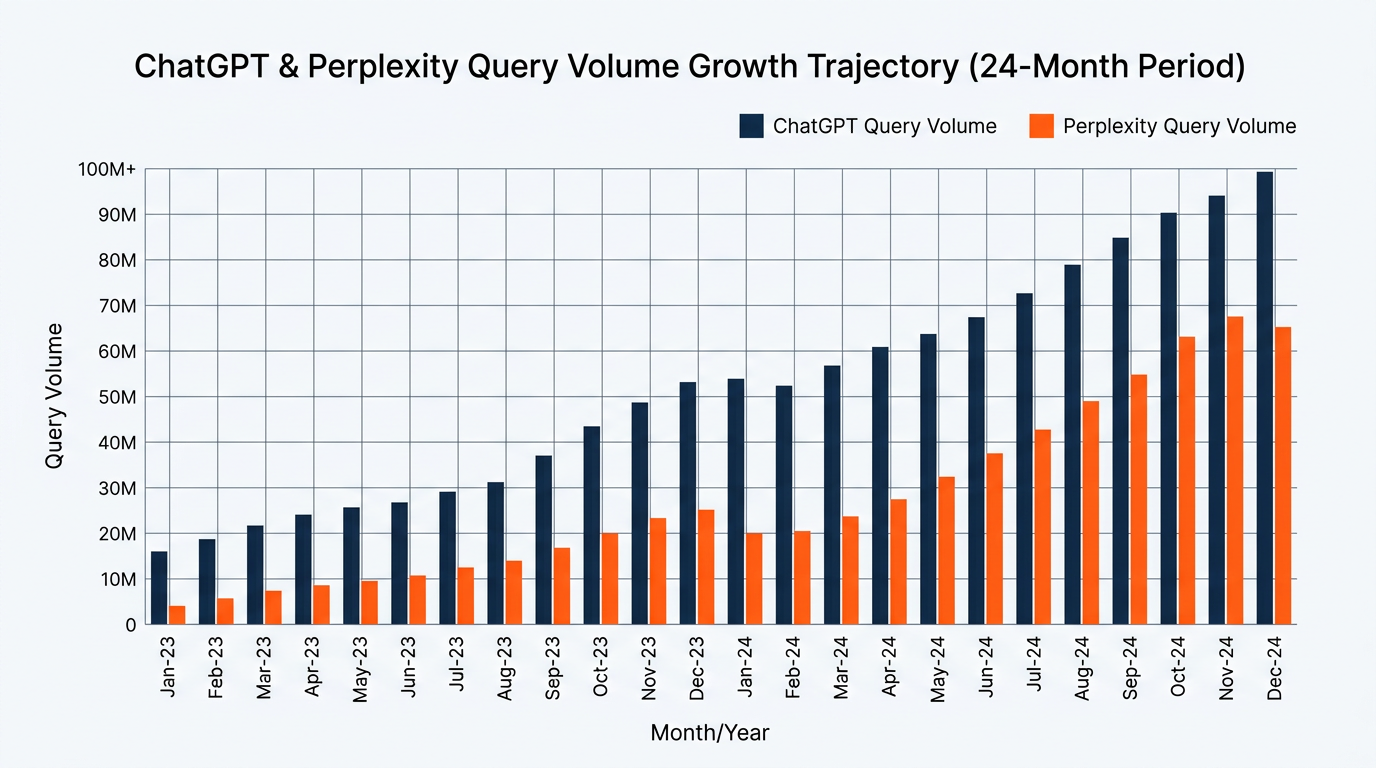
For the businesses Sting serves—insurance agencies, law firms, medical practices, home builders, and e-commerce companies—this represents both an opportunity and a threat. When a prospect asks ChatGPT "What's the best insurance agency in Phoenix for commercial coverage?" or "Which home builders specialize in custom equestrian properties?" your business either gets mentioned or it doesn't. There's no page two. There are no ten blue links to compete for. You're either in the AI's answer or you're invisible.
The challenge is that LLMs don't rank websites—they synthesize information from their training data and retrieval systems to generate responses. This means your carefully optimized title tags and backlink profile don't directly influence whether Claude or ChatGPT mentions your brand. What matters is whether your content has been structured, published, and distributed in ways that make it recognizable as authoritative source material.
What Most Businesses Are Getting Wrong
The most common mistake we see when auditing client visibility is assuming that strong Google rankings automatically translate to AI search visibility. They don't. A business can rank #1 for their primary keyword on Google while being completely absent from ChatGPT and Perplexity responses for the same query. This happens because:
- LLMs prioritize entity recognition over keyword matching—your brand needs to be understood as a distinct entity, not just a collection of optimized pages
- AI systems favor content that directly answers questions in extractable formats, not content optimized for click-through rates
- Citation probability correlates with third-party mentions and authoritative references, not just on-site optimization
- Training data has significant lag—content published today may not influence AI responses for months
This isn't about abandoning SEO. It's about recognizing that search visibility now requires optimizing for two fundamentally different systems simultaneously. Our AI Search Optimization (AEO) services are built specifically to bridge this gap.
The LLM Optimization Framework: Five Strategic Components
Effective LLM optimization isn't a single tactic—it's a systematic approach to making your business recognizable, credible, and citable across the AI ecosystem. Here's the framework we implement with clients:
1. Entity Establishment and Recognition
LLMs understand the world through entities—distinct concepts, organizations, people, and things that have defined relationships to other entities. For your business to be cited by AI, it first needs to exist as a recognized entity in the AI's understanding of your industry.

This requires consistent NAP (Name, Address, Phone) information across all platforms, structured data markup that explicitly defines your organization's properties, and authoritative third-party references that validate your entity status. When we work with law firm clients, we ensure their attorneys appear as distinct entities with clear practice area associations, bar memberships, and case outcome signals that AI systems can parse.
Google's structured data documentation provides the technical foundation, but entity establishment goes beyond schema markup. It requires coordinated presence across Wikipedia, Wikidata, industry directories, professional associations, and authoritative publications that AI systems use as training data and retrieval sources.
2. Answer-First Content Architecture
Traditional SEO content is often structured to maximize time on page and encourage exploration. LLM-optimized content is structured to be extracted. This means leading with direct answers, using clear hierarchical organization, and formatting information in ways that AI systems can parse and attribute.
The practical shift: instead of burying your expertise under compelling introductions and progressive disclosure, you front-load the specific answer to the question your content addresses. This is why our content strategy services now include AEO-optimized formatting for every piece of content we develop.
Key formatting principles:
- Lead every section with a 40-60 word direct answer before elaboration
- Use question-based H2 and H3 headings that match natural language queries
- Include explicit attribution signals—author credentials, methodology references, data sources
- Structure lists and comparisons in consistent, extractable formats
3. Authority Signal Distribution
LLMs assess source credibility through signals distributed across the web, not just on your website. This means your optimization strategy must extend to:
Third-party citations: When industry publications, news sites, and authoritative resources cite your content or quote your experts, AI systems register these as credibility signals. This isn't traditional link building—it's establishing your brand as a citable source within your industry's information ecosystem.
Platform presence: AI assistants often pull from specific platforms—Reddit for consumer opinions, LinkedIn for professional insights, YouTube for how-to content. Your brand needs strategic presence on the platforms AI systems trust for different query types.
Review and reputation signals: For local and service businesses, AI systems synthesize review sentiment across Google Business Profile, Yelp, industry-specific platforms, and social media. The consistency and recency of positive reviews directly influences whether AI assistants recommend your business.
4. Retrieval-Augmented Generation (RAG) Optimization
Modern AI assistants don't rely solely on training data—they use retrieval systems to fetch current information from the web. This is why Perplexity and ChatGPT's browsing mode can cite sources published days or hours ago. Optimizing for RAG means ensuring your content is accessible, well-structured, and explicitly authoritative when these systems retrieve it.
Key RAG optimization tactics:
- Clear, crawlable site architecture with logical URL structures
- Explicit authorship and publication date signals
- Self-referential clarity—content that explicitly states what it is and what entity published it
- Fast, clean HTML rendering without JavaScript dependencies for core content
5. Query-Intent Mapping
Different AI platforms handle different query types. ChatGPT excels at complex explanations and comparisons. Perplexity focuses on research-oriented queries with source attribution. Google AI Overviews prioritize local and transactional intent. Your LLM optimization strategy should map your content to the specific platforms and query types most relevant to your business.
When we audit client visibility, we test queries across multiple AI platforms to identify where they're being cited, where they're absent, and what content gaps exist. This data-driven approach is core to our Generative Engine Optimization (GEO) services.
Want to see how your business performs across AI search engines? Sting's free visibility audit evaluates your current presence in ChatGPT, Perplexity, Google AI Overviews, and traditional search—then identifies the specific gaps limiting your AI search visibility. Get your free audit here or call (888) 858-7776.
Implementing LLM Optimization: A 90-Day Action Plan
Here's the prioritized implementation approach we recommend for businesses serious about AI search visibility:
Days 1-30: Foundation and Audit
Conduct an AI visibility audit. Query your brand name, primary services, and key topics across ChatGPT, Perplexity, Claude, and Google AI Overviews. Document where you're cited, how accurately you're represented, and where competitors appear instead.
Establish entity foundations. Audit and correct NAP consistency across all platforms. Implement Organization, LocalBusiness, and Person schema markup. Verify or create listings on industry-specific directories that AI systems reference.
Identify content gaps. Map the questions your target audience asks AI assistants to your existing content. Prioritize creating or reformatting content for the highest-value queries where you're currently absent.
Days 31-60: Content Optimization
Reformat existing high-performing content. Add answer-first structures, question-based headings, and explicit attribution signals to your most authoritative pages. This often yields faster results than creating entirely new content.
Develop FAQ and comparison content. AI assistants heavily favor content that directly addresses comparative and evaluative queries. "What's the difference between..." and "Which is better for..." queries are high-value targets.
Strengthen author and brand signals. Ensure every piece of content has clear authorship with linked author profiles that establish expertise. This is especially critical for YMYL (Your Money, Your Life) industries like insurance, legal, and healthcare.
Days 61-90: Distribution and Authority Building
Pursue strategic third-party citations. Identify publications, podcasts, and platforms where your expertise can be featured with proper attribution. Guest contributions on authoritative industry sites carry significant weight for LLM credibility.
Optimize platform presence. Ensure your business has active, helpful presence on platforms AI systems reference—LinkedIn for B2B, YouTube for how-to queries, Reddit for consumer research, Google Business Profile for local intent.
Implement monitoring and iteration. Set up regular AI query testing to track changes in visibility. LLM behavior evolves rapidly—what works today may need adjustment in 60 days.
What to Measure
Traditional SEO metrics don't capture LLM performance. Focus on:
- Citation frequency: How often your brand appears in AI responses for target queries
- Citation accuracy: Whether AI systems correctly represent your services, location, and expertise
- Competitor displacement: Changes in which brands appear for high-value queries
- Referral traffic from AI platforms: Track Perplexity and ChatGPT as traffic sources in analytics
Results timeline: Entity establishment and content reformatting can influence RAG-based AI responses within 30-60 days. Training data influence takes longer—typically 90-180 days for significant shifts in how LLMs represent your brand. This is why we emphasize integrating SEO and AI SEO into a unified strategy rather than treating them as separate initiatives.
How Do LLMs Decide Which Businesses to Recommend?
Large language models recommend businesses based on the patterns in their training data and retrieval results, weighted by signals of authority, relevance, and trustworthiness. Unlike Google's algorithm, which evaluates individual pages against specific ranking factors, LLMs synthesize information across thousands of sources to form probabilistic responses. Businesses that appear frequently in authoritative contexts—industry publications, professional directories, customer reviews, and expert discussions—are more likely to be mentioned because they're more strongly represented in the model's understanding of the topic.
This is why entity establishment and third-party citations matter more for LLM visibility than traditional on-page optimization. The AI isn't evaluating your website—it's evaluating your brand's presence across the entire information ecosystem.
What's the Difference Between SEO and LLM Optimization?
SEO optimizes web pages to rank in search engine results pages (SERPs), while LLM optimization ensures your brand and content are recognized, trusted, and cited by AI-powered answer engines. SEO focuses on keywords, backlinks, and technical factors that influence page-level rankings. LLM optimization focuses on entity recognition, content extractability, and distributed authority signals that influence whether AI systems mention your brand when generating responses.
The strategies overlap significantly—well-structured, authoritative content serves both—but the tactical execution differs. Our SEO services and AEO services are designed to work together because businesses now need visibility across both systems.
Can Small Businesses Compete in AI Search?
Yes—and in some ways, AI search levels the playing field for specialized small businesses. LLMs favor expertise and specificity over scale. A boutique law firm that publishes exceptional content about a narrow practice area can be cited more frequently than a national firm with generic content. The key is establishing clear expertise signals within a defined niche rather than competing broadly.
For local businesses, AI assistants increasingly reference Google Business Profile data, local reviews, and proximity signals. This means a well-optimized local presence can generate AI recommendations even for businesses without extensive content marketing resources. The businesses struggling most are those in the middle—large enough to face serious competition but without the niche expertise signals that make smaller specialists stand out.
The Bottom Line: Visibility Requires a Dual Strategy
The question isn't whether to optimize for LLMs or traditional search—it's how to build a unified strategy that captures visibility across both systems. Businesses that treat AI search as a separate initiative from SEO are duplicating effort and missing the compounding benefits of content that serves both simultaneously.
Sting Marketing's approach integrates traditional search engine optimization with generative engine optimization because that's what modern visibility requires. Our free visibility audit evaluates your presence across Google, ChatGPT, Perplexity, and AI Overviews to identify exactly where you're winning, where you're invisible, and what strategic adjustments will have the highest impact.
The businesses figuring out LLM optimization now will own the AI search landscape for the next decade. Get your free visibility audit at sting.net/contact or call (888) 858-7776.
This article reflects Sting Marketing's experience and methodology as of the publication date. Search engine algorithms, AI platforms, and digital marketing best practices evolve continuously. For a strategy tailored to your specific business, market, and goals, schedule a free growth audit or call (888) 858-7776.