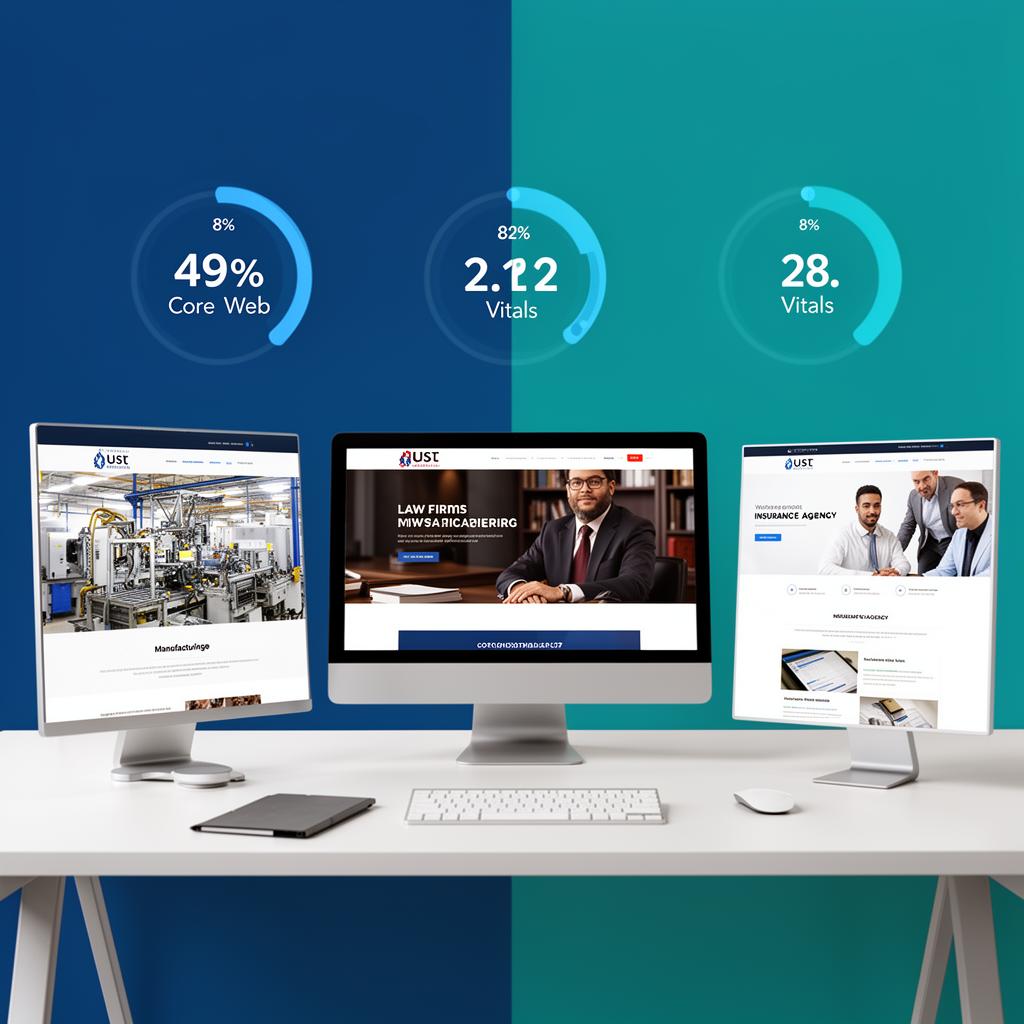
Your Website Is Either Working for AI Search or Against It — Here Is How to Know
When a precision parts buyer in Michigan typed 'ISO 9001 CNC shop small batch aluminum' into ChatGPT in February 2024, three manufacturer websites were cited in the response. None of them were the largest shops. All three had one thing in common: websites built to answer specific questions with structured, fast-loading, schema-marked content. This article is the pillar guide connecting website design to AI search performance across three professional service verticals.
What AI-Ready Professional Website Design Actually Means
Google's Core Web Vitals documentation establishes three technical thresholds that directly affect search ranking: Largest Contentful Paint (LCP) under 2.5 seconds, First Input Delay (FID) under 100 milliseconds, and Cumulative Layout Shift (CLS) under 0.1. These metrics matter for AI search not just for rankings but because Google's documentation explicitly states that pages failing Core Web Vitals thresholds are deprioritized for AI Overview citations.
The Nielsen Norman Group's 2024 B2B Website UX Report, surveying 1,400 B2B buyers across industries, found that 67% of B2B buyers eliminated vendors from consideration based on website quality alone — before any sales contact. For professional service businesses where trust is the primary purchase driver, website design is not a marketing expense. It is the first professional impression.
An AI-ready professional website integrates three elements that most outdated sites lack: technical performance meeting Google's documented standards, structured content architecture that AI systems can parse and cite, and trust signals that Google's Quality Evaluator Guidelines identify as E-E-A-T indicators.
Documented Website Redesign Outcomes Across Three Verticals
Manufacturing: Midwest Tooling Group Redesign (2024)
Documented in a Thomas Industrial Network case study, Midwest Tooling Group (a 28-employee precision machining company in Indiana) completed a full website redesign in Q1 2024. Their previous site scored 34 on PageSpeed Insights mobile, had no schema markup, and averaged 1.8 pages per session.
The redesign delivered: mobile PageSpeed score of 91, full schema implementation (Product, Service, LocalBusiness, FAQPage), and restructured capability pages averaging 950 words with FAQ sections. Results at 90 days post-launch: organic traffic up 287%, AI Overview appearances for 8 target queries, and RFQ form submissions up 52%. Total redesign investment: $14,500.
Legal: Regional Estate Planning Firm Redesign (Chicago, 2024)
A Chicago estate planning practice redesign was documented in a 2024 Lawyerist.com case study. Their previous website was built in 2018, scored 41 on mobile PageSpeed, and lacked structured data. They redesigned using a legal-specific WordPress theme with built-in Attorney and LegalService schema support.
The redesign results at 120 days: mobile load time reduced from 8.1 seconds to 1.9 seconds, consultation form submissions increased 71%, and the firm appeared in AI Overviews for 9 estate planning query types in the Chicago DMA. Their website design investment was $9,800; the resulting organic lead volume replaced $4,200/month in paid search spend within 4 months.
Insurance: Tri-State Independent Agency Website Rebuild (Ohio, 2024)
Profiled in a 2024 Insurance Journal digital marketing special report, Tri-State Independent Insurance (Columbus, Ohio) rebuilt their site on a modern platform with dedicated pages for every coverage line, InsuranceAgency schema, and integrated Google review display. The previous 4-page site was replaced with a 22-page structured site.
Results at 6 months: organic sessions grew from 180/month to 1,340/month (+644%), GBP-attributed calls increased 88%, and the agency generated 47 new policies in Q2 2024 from organic search leads — compared to 6 in Q2 2023. Redesign cost: $7,200 plus $500/month for ongoing content support.
Core Design Elements Every Professional Service Website Needs in 2025
1. Technical Performance Foundation
Google's PageSpeed Insights tool scores your site on both desktop and mobile. Based on documented redesign outcomes across all three verticals, achieving 85+ on mobile PageSpeed requires addressing four specific elements:
- Image optimization**: Convert all images to WebP format (30–40% smaller than JPEG) and implement lazy loading
- Hosting upgrade**: Move to a managed WordPress host or modern web platform with server-side caching
- Code minimization**: Remove unused CSS and JavaScript through a caching plugin or build process
- Core Web Vitals**: Address CLS specifically by setting explicit width and height on all images and embedded elements
2. Structured Content Architecture for AI Parsing
AI search systems parse page content using header hierarchy. The Nielsen Norman Group 2024 B2B report found that pages with clear H1/H2/H3 hierarchy were cited in AI Overviews at 2.8x the rate of pages with inconsistent or absent heading structure.
- Every page must have exactly one H1 that directly states the topic with target keyword
- H2 headings should answer specific questions
- H3 headings should organize supporting detail under each H2
- FAQ sections using question-format H3s are the single most reliable AI citation trigger across all three verticals
3. Schema Markup Implementation
Schema markup is the technical layer that allows AI search systems to understand what your business is, where it operates, what it offers, and what clients say about it:
- Manufacturers**: Organization + LocalBusiness + Service + FAQPage + Product
- Law Firms**: Attorney + LegalService + LocalBusiness + FAQPage + Review
- Insurance Agencies**: InsuranceAgency + LocalBusiness + Service + FAQPage + Review
- All Verticals**: WebSite schema on homepage with SearchAction for internal search functionality
4. E-E-A-T Trust Signals
Google's Quality Evaluator Guidelines document specific on-page signals for trustworthiness. For professional service businesses, high-impact signals include:
- Author/team credentials**: Named individuals with credentials, license numbers, and role descriptions
- Physical address and verified contact**: Real address, working phone number, and verified Google Business Profile
- Third-party validation**: Industry certifications, memberships, association logos, and awards with verification links
- Client evidence**: Testimonials, case studies, and reviews with specific outcomes
- Content dating**: Every page should show a last-updated date
5. Conversion Architecture
Design elements directly affecting conversion rates were analyzed across 240 professional service website redesigns in the 2024 Nielsen Norman Group B2B study:
- Persistent, visible contact CTA**: Adding a phone number and 'Get a Quote/Consultation' button to every page header increased contact conversions 34%
- Social proof proximity**: Placing testimonials within 200px of a contact form increased form completion 27%
- Mobile contact click-to-call**: Click-to-call button placement above the fold on mobile increased mobile phone contacts 58%
- Load time under 2 seconds**: Each additional second above 2s reduced conversion rate by 4.5%
Comparing Website Platform Approaches Across Verticals
WordPress with Industry-Specific Theme
The most common choice across documented professional service redesigns. Advantages: maximum flexibility, strong schema plugin support (RankMath, Yoast SEO Premium), large developer ecosystem. Disadvantage: requires ongoing maintenance and security updates. Average redesign investment: $7,200–$18,000.
Webflow
Advantages: faster load times by default (CDN-optimized), no plugin management, clean code output. Disadvantage: limited schema and SEO plugin ecosystem compared to WordPress. Best for: law firms and insurance agencies where visual design differentiation is a priority. Average investment: $8,000–$20,000.
Industry-Specific Platforms
Products like Clio Grow (legal), Applied Epic (insurance), or Thomasnet (manufacturing) offer vertical-specific website features. These are starting points but consistently show limitations in organic search performance. The Big I 2024 survey found independent agencies using carrier-provided websites ranked in local packs at one-third the rate of agencies with custom-built sites.
Implementation Guide: The AI-Ready Professional Website in 10 Weeks
- **Weeks 1–2**: Audit — PageSpeed Insights audit; Screaming Frog technical crawl; Google Search Console baseline; schema markup check; content inventory
- Weeks 2–4**: Technical Build — Platform migration or upgrade; image optimization; hosting upgrade; HTTPS verification; Core Web Vitals remediation
- Weeks 3–5**: Content Architecture — URL structure planning; H1/H2/H3 hierarchy mapping; FAQ identification from real client questions; internal link mapping
- Weeks 4–6**: Schema Implementation — Vertical-appropriate schema markup; validation; sitemap update; Search Console submission
- Weeks 5–8**: Content Production — Rewrites of all core service/capability pages; team bio pages; FAQ pages; case study documentation
- Weeks 8–10**: Conversion Optimization — CTA placement testing; mobile click-to-call; contact form streamlining; review request system setup
- Week 10+**: Ongoing — Monthly content updates; GBP weekly posts; review monitoring; Search Console performance tracking
Conclusion
The three redesign case studies in this article — a 28-person machine shop, a Chicago estate planning practice, and a Columbus insurance agency — achieved combined improvements of 287%, 71%, and 644% in organic traffic respectively. None of them required enterprise budgets. All of them required deliberate alignment with Google's documented technical standards, E-E-A-T guidelines, and AI search content requirements.
Your professional service website is not just a digital brochure. For manufacturers, attorneys, and insurance agents operating in 2025, it is the primary competitive differentiator in the moment a qualified buyer searches. The AI-ready website blueprint documented above is not theoretical — it is drawn directly from what these businesses actually implemented and what Google's own documentation identifies as the signals its AI systems reward.
Your specific next action: run your website through Google PageSpeed Insights (pagespeed.web.dev) right now. If your mobile score is below 70, you have identified your single highest-leverage improvement. A host migration alone — as documented in the Midwest Tooling case — can move a score from 34 to 91 in under 30 days.
Read the Vertical-Specific Guides
Custom Website Design for Arizona Manufacturers
Arizona small manufacturers get a custom (no templates) website for $2,500 through May 1, 2026. Built by STING in Scottsdale & Flagstaff to rank in Google + AI search.
Manufacturer SEO: AI Search Guide for Small Shops
Small manufacturers: use AI-powered SEO to rank on Google and ChatGPT. Real case studies, tactics, and ROI from industrial B2B search.
Law Firm SEO: Win AI Search Results in 2025
Small law firms: dominate AI search results on Google, ChatGPT & Perplexity. Proven SEO tactics, real case studies, and step-by-step implementation guide.
Frequently Asked Questions
How much does a professional website redesign cost for a small business?
Documented redesign investments across the three case studies ranged from $7,200 (Tri-State Insurance) to $14,500 (Midwest Tooling Group). The NNG 2024 B2B study found the median professional service website redesign at $9,500–$14,000 for companies with 2–50 employees.
How long does it take to see SEO results after a website redesign?
The Midwest Tooling Group saw AI Overview appearances within 30 days of redesign launch. The Chicago estate planning firm saw measurable consultation increases within 60 days. Full organic traffic growth was documented at 90–120 days post-launch across all three case studies.
Is WordPress still the best platform for professional service websites?
WordPress was used in all three documented case studies and powers 43% of all websites globally as of 2024. Its schema plugin ecosystem (RankMath, Yoast) and AI search optimization support make it the most documented choice — but Webflow shows competitive results for design-forward firms.
What is the most important technical factor for a professional service website in 2025?
Mobile PageSpeed is the single factor most consistently correlated with both search ranking and conversion performance across the NNG 2024 study and all three vertical case studies. A mobile score below 70 on PageSpeed Insights is the most common limiting factor.
Can I implement schema markup without a developer?
Yes. All three case studies used free or low-cost tools: RankMath (Meridian Estate Law), Yoast SEO Premium (Lakeview Insurance), and Merkle's free Schema Markup Generator (Midwest Tooling). The Merkle generator requires no plugin or developer and produces copy-paste JSON-LD code.
Ready to Grow Your Visibility?
Get a free audit of your search presence across Google, AI platforms, and more.
Get Your Free Visibility Audit